The system of record for cryptographic transformation.
Navigator helps organisations govern cryptographic change across systems, owners, standards, risks, actions and evidence.
Cryptographic transformation cannot be managed through disconnected scans, spreadsheets and static reports. Organisations need a persistent operating record that shows what is in scope, who owns it, what must change, what has been decided, what evidence exists and how progress is being governed.
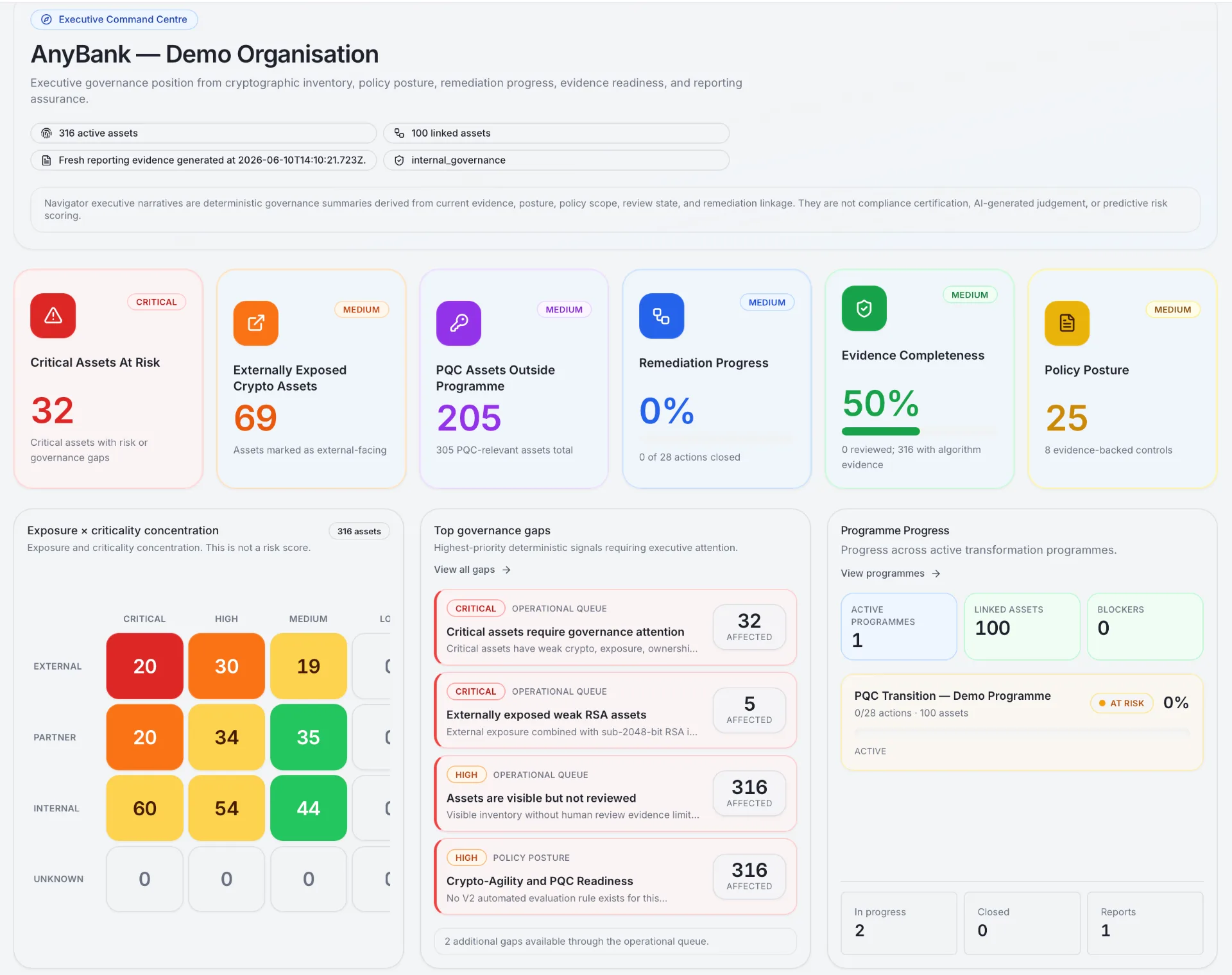
Navigator turns cryptographic visibility into governed action.
Navigator helps organisations move from fragmented discovery outputs to a single, continuously maintained cryptographic operating record.
- Establish a cryptographic inventory and CBOM-informed operating view
- Map cryptographic assets to systems, owners and business services
- Prioritise remediation and transition activity
- Track standards, policy and regulatory alignment
- Coordinate remediation work across responsible teams
- Capture evidence for boards, auditors, regulators and customers
- Maintain an executive view of cryptographic transformation progress
- Record accepted risk as a governed exception with an approver, a reason and an expiry
- Maintain a supplier register of post-quantum positions, with evidence and measured coverage
A governance record is only worth keeping if you can take it with you.
The cryptographic inventory Navigator governs is expressed in CycloneDX — a published standard rather than a schema of ours. The record you build is readable by anything that reads CycloneDX.
Reports are produced by deterministic template logic. No generative model writes the numbers or the narrative, and a runtime check asserts that the figures quoted in the prose match the counts they are drawn from. Where evidence is absent, the platform reports it as absent — never as a pass.
Decisions outlive the people who made them. The rationale, the owner and the moment are recorded with the decision, so a governance position taken three years ago is still readable by whoever inherits it.
Three capabilities. One operating record.
- Cryptographic assets
- Algorithms and protocols
- Certificates and PKI dependencies
- Software and library dependencies
- System and application ownership
- Exposure and readiness context
- CBOM and discovery inputs
The result is not just discovery. It is a governed view of what matters.
- Programme scope and inclusion decisions
- Ownership assignment
- Prioritisation
- Remediation planning
- Policy and standards alignment
- Lifecycle-driven governance
- Review and decision tracking
- Partner and delivery coordination
The objective is to move from fragmented awareness to governed execution.
- Programme reporting
- Audit-ready evidence records
- Executive dashboards
- Remediation status tracking
- Readiness and maturity views
- Decision history
- Reporting packs for stakeholders
The goal is not only to know the risk. The goal is to prove that the organisation is managing it.
Designed to complement existing tools.
Navigator is not a scanner, PKI replacement, certificate lifecycle management replacement, generic GRC platform or black-box scoring engine.
It is the cryptographic governance and transformation layer that sits above and alongside existing tools — providing the cryptography-specific operating record for ownership, programme state, evidence and transformation progress.
Find where cryptography exists.
Operate certificates and trust infrastructure.
Manage broad enterprise risk workflows.
Governs cryptographic ownership, action, evidence and transformation progress.
One operating layer. Multiple cryptographic governance use cases.
Navigator supports the cryptographic governance disciplines enterprises need today — and the ones emerging as post-quantum readiness expectations mature.
Ready to establish your cryptographic system of record?
Request a Navigator demo and see how cryptographic inventory, ownership, remediation, evidence and reporting can be governed in one operating layer.