Govern cryptographic change before it becomes operational disruption.
The hard part isn’t choosing an algorithm. It’s knowing what you use, where it sits, who owns it, and how to change it without breaking the business.
CipherWyze provides the system of record, governance model and programme execution capability required to manage cryptographic transformation at enterprise scale.
Cryptographic transitions become customer-impacting operational events.
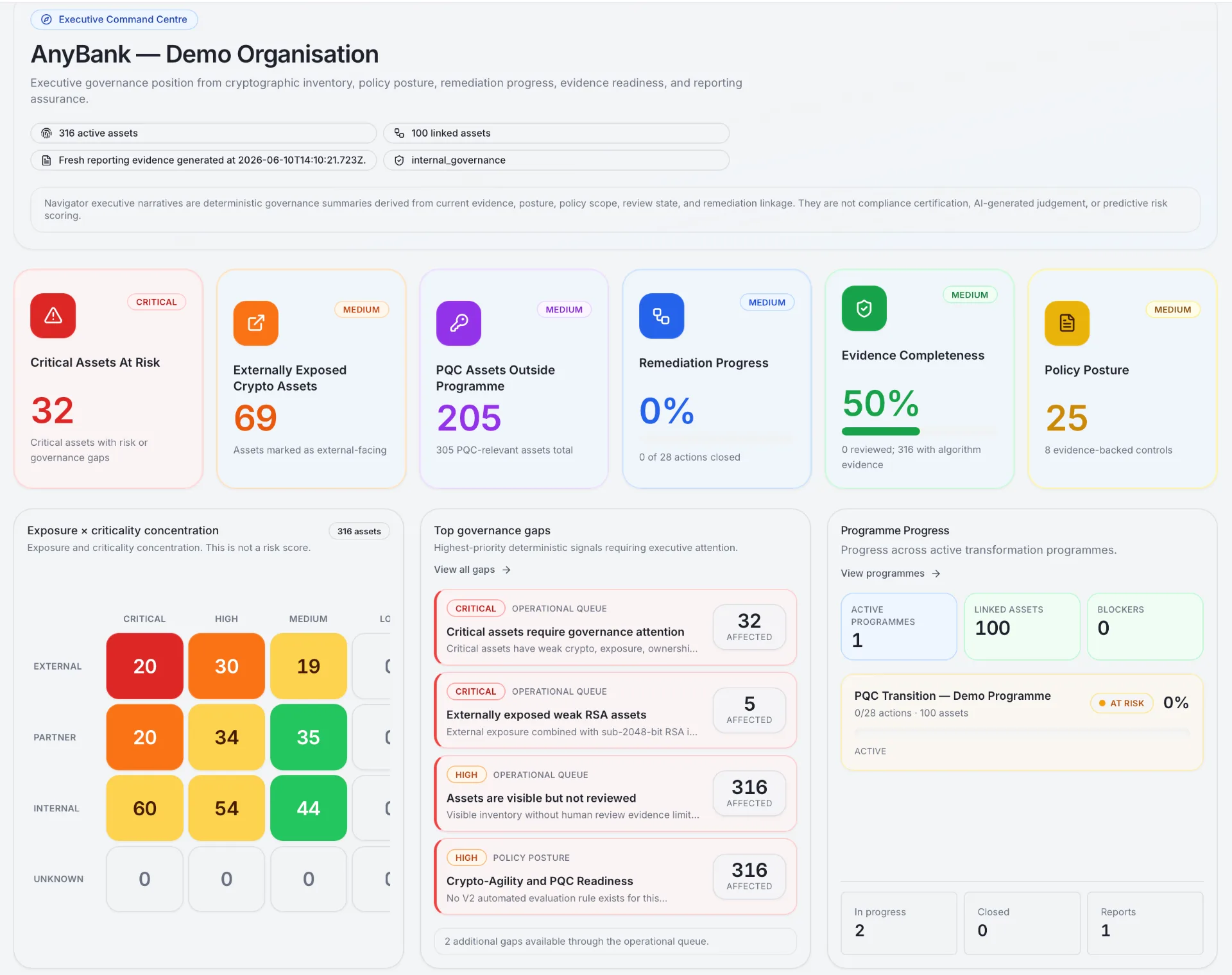
Most organisations are at stages three and four of the PQC Reality Curve™: the risk reads like Y2K again, and AI is absorbing the executive attention and budget a cryptographic transition needs. Stage five is already moving — supervisors are testing the ICT-risk obligations institutions already carry against their cryptographic exposure, and that scrutiny tightens from here. Left to run, the sequence is predictable: inventory shock, then migration panic — the discovery that there is not enough time left to migrate ahead of the dates that matter. The governed path exits before the peak. We take our customers from regulatory awakening directly into structured governance and programme delivery, and on to crypto-agility as an embedded capability.
“Cryptographic transitions fail operationally before they fail mathematically.”
The PQC Reality Curve
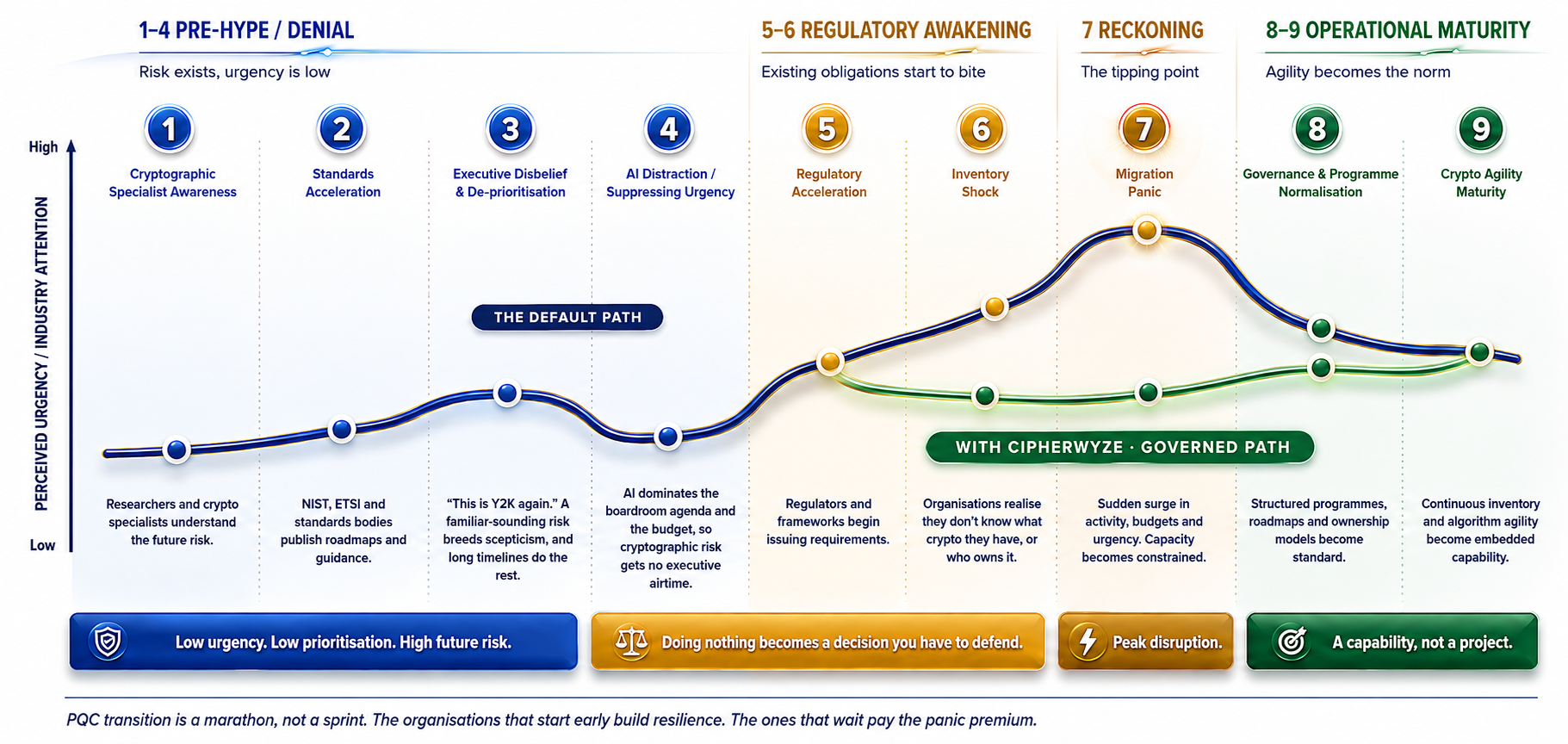
What the calendar actually requires
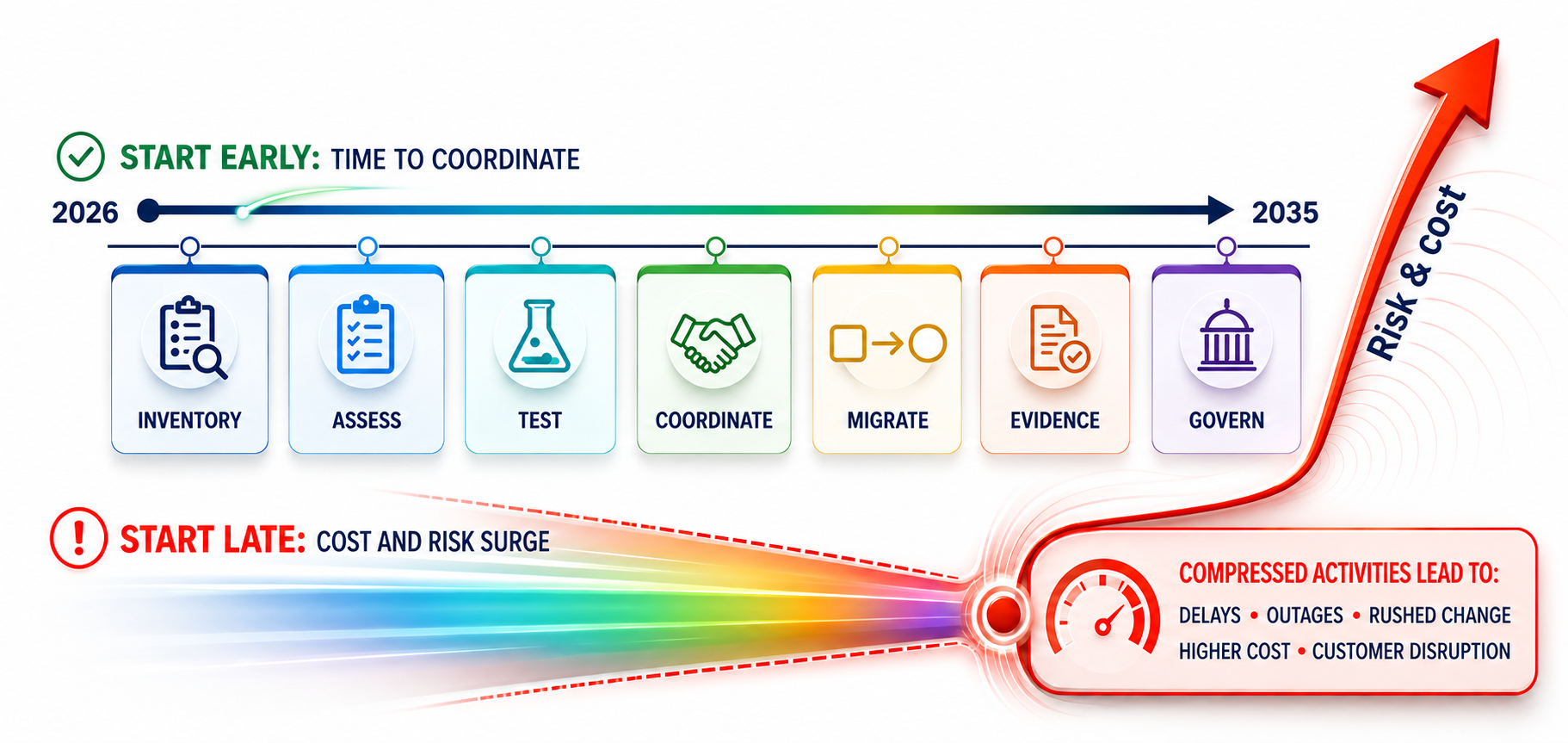
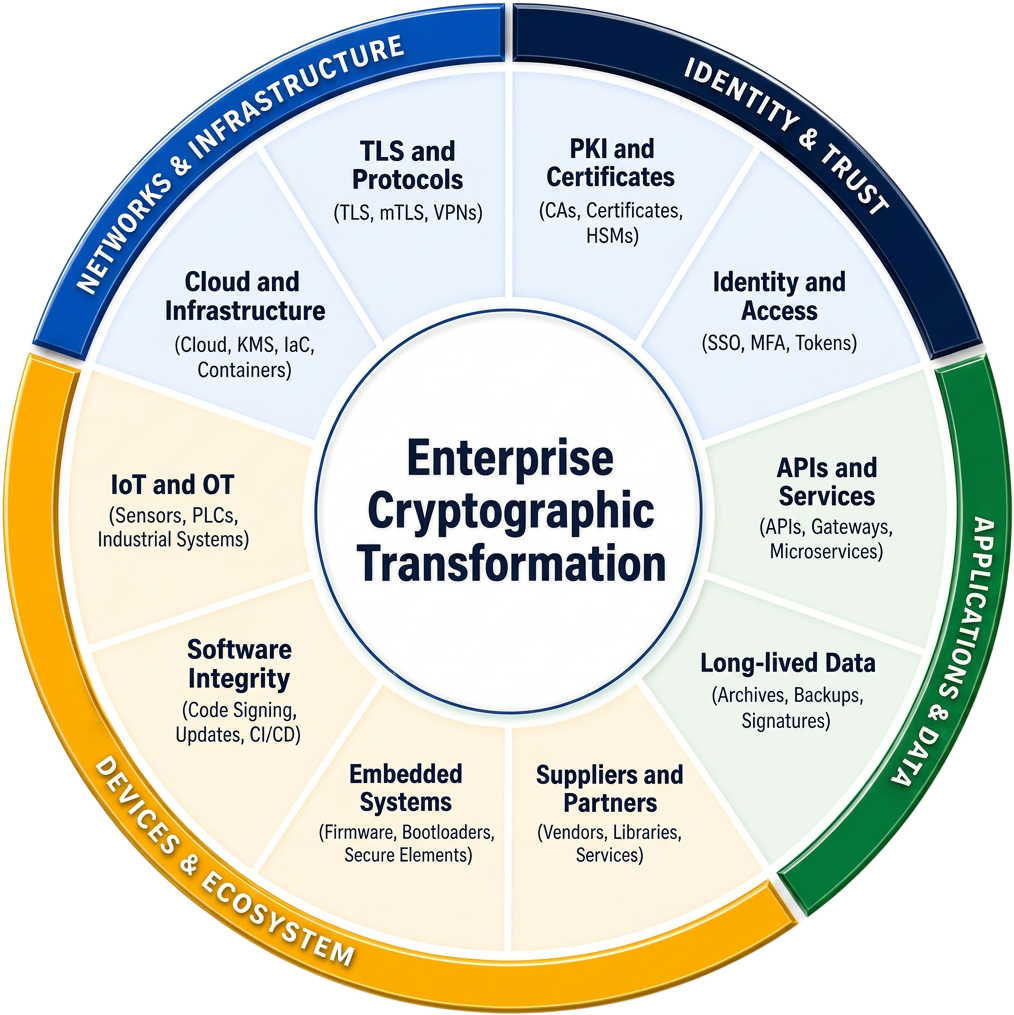
Cryptographic change extends across the entire enterprise technology estate — identities, certificates, protocols, APIs, cloud infrastructure, software delivery pipelines, suppliers, operational technology, embedded systems and long-lived data.
Scanners tell you what cryptography you have. CipherWyze governs what you do about it.
Scope, ownership, decisions, evidence and transformation progress, held as a persistent operating record rather than a point-in-time view.
Three mechanisms do most of the work.
When someone records an owner, a criticality, an exposure or a readiness status, that judgement is held. Later scans keep adding observations, but they do not overwrite the organisation’s position on assets it has already governed. That is the difference between a scan output and a system of record, and it is enforced in the data model rather than by convention.
Scope determines which assets are eligible for a programme. A named person decides which are actually included, and removing one requires a recorded reason. Every governed number — every figure that reaches a board pack — is drawn from the included set. Scope cannot widen quietly between one report and the next.
Completing a remediation action requires either attached evidence or a recorded exception with a written justification. A programme gate can be passed while readiness is poor — but the decision is attributable, carries a rationale, and freezes the readiness position exactly as it stood when the call was made.
Attribution is the common thread. Every governance state in the platform traces to a named person, a recorded rationale and a timestamp. The machine computes; it does not decide.
- Regulated environments
Built for organisations where cryptography underpins identity, payments, infrastructure, customer trust and regulated services.
- Board & audit evidence
Designed for programmes that need ownership, evidence, auditability and executive reporting — not just technical findings.
- Standards-aware
Supports cryptographic governance across PKI, TLS, PQC, certificate lifecycle, algorithm exposure and digital operational resilience.
The report that goes to your board is signed. Twice.
Navigator signs every governance report it issues with two signatures: Ed25519, and ML-DSA-65 — the post-quantum signature standard NIST published in 2024. Any alteration to a published report is detectable, and the key that issued it is provable. We did it that way for the same reason we would advise you to: during a transition you carry both, so today’s verification tooling can read the classical signature while the post-quantum one protects the record’s integrity into the period the transition exists to prepare for.
What the signature does not do is vouch for the content. It proves the report is unaltered and identifies who issued it — whether the decisions inside it were the right ones remains the judgement of the people who made them, and Navigator says so on the verification screen rather than leaving you to assume the proof covers more than it does.
One platform. Multiple cryptographic governance applications.
Navigator is deployed against the cryptographic governance use cases enterprises face today — and the ones emerging over the next decade.
Unified, continuously enriched view of cryptographic assets and dependencies.
Quantify exposure, prioritise remediation and track residual risk.
Centralised lifecycle, ownership and policy enforcement for certificates.
Coordinate certificate and protocol modernisation across the estate.
Plan, govern and evidence enterprise PQC transition programmes.
Govern cryptographic evidence in support of ICT risk and operational resilience obligations.
Accepted risk with a named approver, a reason and a date it comes up for review.
Where each supplier stands on post-quantum readiness, with the evidence behind it.
CipherWyze operates through specialist partners.
CipherWyze operates through specialist partners who provide advisory, transformation and delivery services.
Navigator provides the governance platform and system of record that enables large-scale cryptographic transformation programmes.
- 01Regional delivery partners
- 02Cryptographic advisory services
- 03Transition programme governance
- 04Inventory and discovery integration
- 05Ongoing operational support